Flow
The Wind-Up Bird ChronicleFlow is the novel’s image for an underlying movement that governs when events can advance and when action must stop. It first gives a possible explanation for the missing cat, then becomes Mr. Honda’s practical counsel to Toru Okada: move when movement is called for, remain still when it is not, and do not try to force what has not begun. The idea joins prophecy to restraint, and makes waiting a consequential form of action rather than mere passivity.
The Missing Cat and a Changed Current
When Toru Okada asks why the cat has left after living with him and Kumiko for so long, Malta Kano cannot explain the timing. She offers a possibility instead: perhaps the flow has changed, or something has obstructed it. Her uncertainty matters; flow names a condition sensed through its effects, not a mechanism she can diagnose. She is more definite about the consequence: the cat is no longer near the house and will never be found in that neighborhood.
The conversation makes the cat’s disappearance the first sign of a larger disturbance. After Malta Kano takes Toru Okada’s hand, she tells him that many different things are about to happen and that the cat’s disappearance is only the beginning. The coming changes will not divide neatly into favorable and unfavorable outcomes: bad things may initially seem good, while good things may seem bad. Flow therefore signals not a promise that events will resolve comfortably, but a changing order whose meaning can only become clear with time.
Mr. Honda’s Counsel
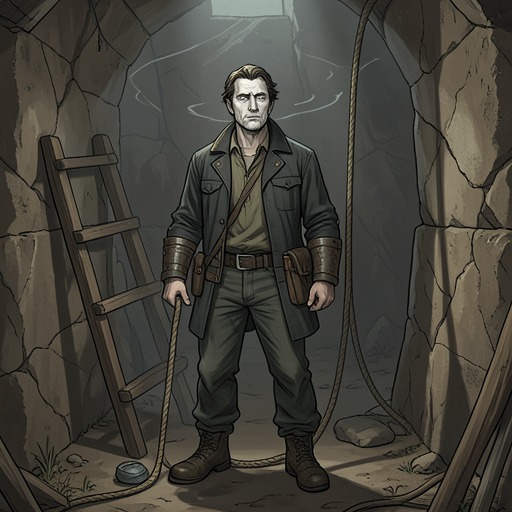
Mr. Honda turns flow into a rule for conduct. He rejects the idea that Toru Okada’s situation can be judged by the ordinary world’s stable divisions and says that what matters is not resisting the current. When it is time to go up, one should climb to the highest tower; when it is time to go down, one should find the deepest well and descend to the bottom. When there is no flow, the task is to stay still. Resistance, he warns, dries everything up, leaving the world in darkness.
His advice is not simply an instruction to follow impulse. It depends on discerning which condition applies: movement upward, movement downward, or a pause. The image of the well gives that principle a particularly severe form. Descent is not automatically an error or a defeat; when the current calls for it, going all the way down is the proper response. Conversely, activity can be dangerous when the time is one of stillness.
Stillness, Water, and Danger
Kumiko asks whether the present is one of the times when there is no flow. Mr. Honda answers that there is no flow now and advises her and Toru Okada to do nothing. His stillness has a specific companion: a warning to be very careful of water. He predicts future suffering involving water that is absent where it should be or present where it should not be, but cannot say what form that danger will take. The warning makes blocked movement and misplaced presence echo one another: what matters is not water in the abstract, but its failure to be where it belongs.
Mr. Honda grounds his demand for patience in his wartime experience. At the river, Soviet tanks equipped with flamethrowers, machine-gun positions, and sharpshooters guarded the crossing. The Japanese soldiers had Model 38 rifles and twenty-five bullets each; most of his companions could not endure waiting and went toward the river, and none returned. He draws from their deaths a blunt rule: when the time is to stay still, stay still. Waiting for the flow to begin may be hard, but when waiting is required one must wait; in the meantime, he tells Toru Okada to assume he is dead. The advice carries the weight of a remembered failure to distinguish urgency from the right moment.
Flow as Narrative Form
The concept shapes the story’s movement as well as its characters’ choices. Malta Kano’s forecast makes the cat’s disappearance an opening rather than a self-contained loss, while the later encounter with Creta Kano is described as the flow of Toru Okada’s life being led into stranger directions. The repeated image gives disparate developments a shared pattern: events arrive as changes in current, and their significance is not always legible at the moment they occur.
Flow also resists a simple moral timetable. Since a bad thing may first look good and a good thing bad, the initial appearance of an event cannot settle its eventual meaning. The novel’s counsel is accordingly double-edged: accept that movement may carry one downward as well as upward, but do not invent movement where none exists. The discipline is to remain responsive without forcing a result—to recognize that both descent and stillness can belong to the proper course.